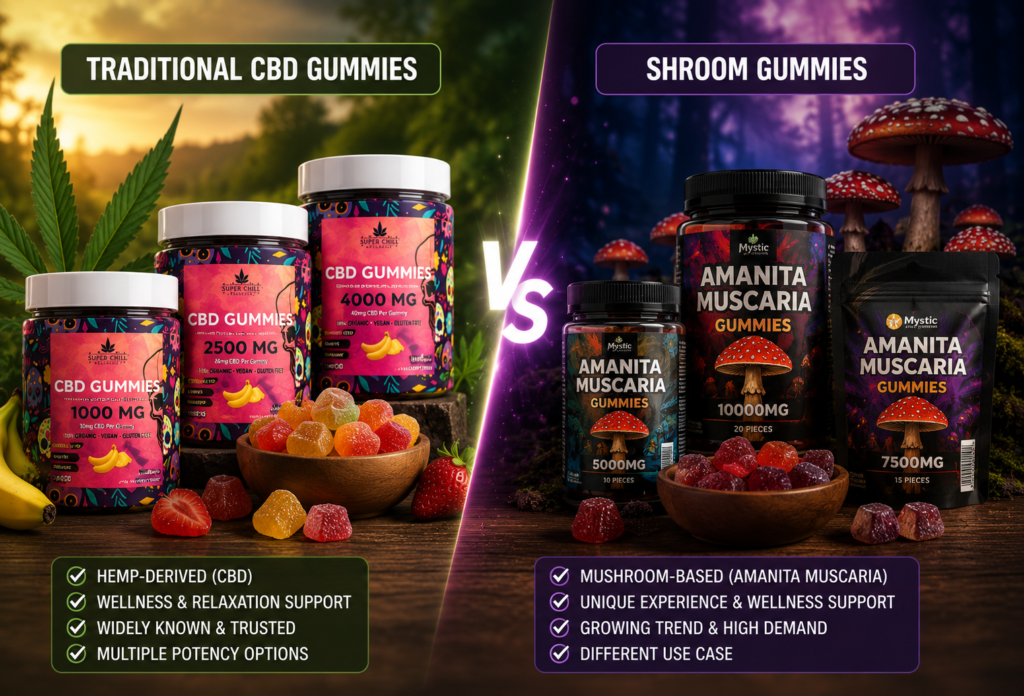
Walk into any smoke shop or wellness store today and you’ll notice something: the gummy shelf looks a lot different than it did just a couple of years ago. Traditional CBD gummies are still steady sellers, but a new category — mushroom-based gummies like Amanita Muscaria — is quickly carving out shelf space next to them.
For retailers and distributors, understanding why customers are shifting (or expanding) their preferences between these two categories can directly impact what you stock, how you market it, and how much margin you capture. Here’s a breakdown of the current demand trends.
Traditional CBD Gummies: The Reliable Foundation
CBD gummies have been a category staple for years, and for good reason:
- Widespread familiarity — Most customers already know what CBD is and what to expect from it.
- Broad appeal — From first-time buyers to regulars, CBD gummies attract a wide age range and comfort level.
- Predictable reorder cycles — Once a customer finds a strength and flavor they like, they tend to become repeat buyers.
- Range of potency options — From 1000MG to 5000MG jars, retailers can serve casual users and experienced customers alike.
CBD gummies remain the dependable core of most gummy displays — the product customers already trust, which makes it easier to sell alongside newer categories.
Also Read: Overnight Shipping & Supply Chain: Why Reliability Matters More Than Price
The Rise of Shroom Gummies
Mushroom-based gummies — particularly Amanita Muscaria products — have moved from niche curiosity to a fast-growing demand category. A few factors are driving this shift:
- Curiosity-driven customers. A segment of shoppers actively seek out newer, less mainstream products. Shroom gummies tap into that “what’s next” mindset that CBD alone doesn’t always satisfy anymore.
- Different experience, different use case. Customers aren’t necessarily replacing CBD gummies — they’re adding shroom gummies for a different kind of experience, often shopping for both categories in the same visit.
- Social and online buzz. Interest in mushroom-derived products has grown significantly through online discussion and word-of-mouth, which pushes foot traffic into physical stores asking for it by name.
- Retailer differentiation. Shops that stock trending shroom products stand out from competitors still offering only standard CBD lines — giving them an edge with customers looking for something new.
What This Means for Retailers
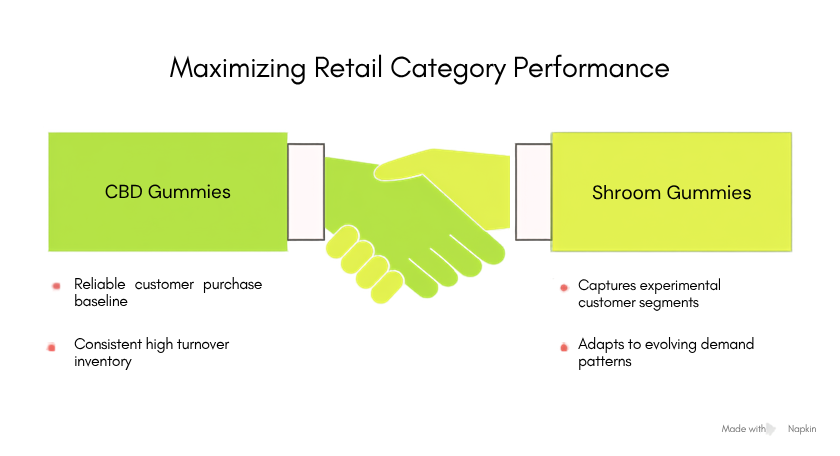
The data and shelf trends point to one clear takeaway: this isn’t an either/or decision. The strongest-performing stores are carrying both categories strategically.
- Keep CBD gummies as your steady, high-volume category — they’re the trusted entry point for most customers.
- Add shroom gummies as a growth and differentiation category — especially in stores with a younger or more experimental customer base.
- Cross-merchandise both — placing them near each other lets curious CBD customers explore shroom products without a separate buying decision.
- Watch reorder patterns closely — shroom gummy demand is still evolving faster than the more established CBD category, so inventory flexibility matters.
Potency & Variety Still Drive Purchase Decisions
Across both categories, customers respond to clear potency labeling and variety. Whether it’s a 1000MG CBD gummy jar or a 5,000MG–10,000MG shroom gummy option, shoppers increasingly compare strength and value per jar before deciding — which means retailers offering a range of potencies across both lines tend to capture more of the market than those with a single option.
The Bottom Line
CBD gummies aren’t going anywhere — they remain the dependable backbone of the gummy category. But shroom gummies represent one of the fastest-growing customer interests in the space right now, and retailers who stock both are better positioned to capture a wider range of shoppers walking through their doors.
At Superchill Wholesale, we carry both traditional CBD gummies and trending Amanita Muscaria shroom gummies — lab-tested, competitively priced, and ready to help your store meet demand across both categories.
Frequently Asked Questions
1. What is the difference between shroom gummies and CBD gummies?
Shroom gummies are mushroom-based products, while CBD gummies contain cannabidiol (CBD), a compound derived from hemp or cannabis. They are different product categories with different customer preferences and intended experiences.
2. Are shroom gummies becoming more popular?
Interest in mushroom-based gummies has increased as customers look for newer and different products. Demand can vary significantly by location, customer demographics, and local regulations.
3. Should retailers stock both CBD gummies and shroom gummies?
For retailers whose customers are interested in both categories and where permitted by law, carrying both can provide more product variety and help serve different customer preferences.
4. Why are customers interested in shroom gummies?
Curiosity, online conversations, product novelty, and interest in mushroom-based products can all contribute to customer demand. Retailers should monitor local buying patterns rather than assuming the same trend applies everywhere.
5. Do customers compare potency when buying gummies?
Yes. Customers often compare labeled strength, serving information, flavors, package size, and price when choosing between products. Clear and accurate labeling can make it easier for shoppers to compare options.

One comment
Pingback:
How To Choose The Best CBD For Vaping: A Complete Guide