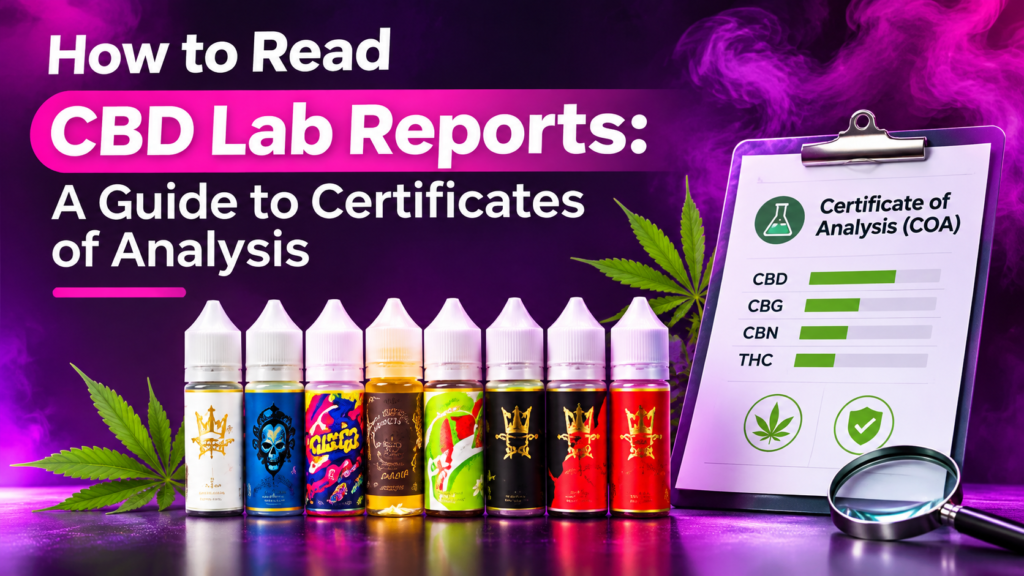
How to Read CBD Lab Reports: A Guide to Certificates of Analysis
How to Read CBD Lab Reports: A Guide to Certificates of Analysis
When exploring CBD products, understanding what’s inside the bottle or package is just as important as knowing the product name. Product labels may mention cannabinoid concentrations, hemp extracts, and different formulations, but how can buyers verify that information?
This is where CBD lab reports become useful.
A CBD lab report, commonly known as a Certificate of Analysis (COA), provides detailed information about a product’s tested composition. It can show cannabinoid levels, identify certain contaminants, and help buyers understand whether the tested product matches its advertised specifications.
However, reading a laboratory report can feel confusing, especially when it contains technical terms, percentages, and measurement units.
In this guide, we’ll explain how to read CBD lab reports, what information to look for in a Certificate of Analysis, and why third-party CBD testing matters when evaluating product quality.
What Are CBD Lab Reports?
CBD lab reports are laboratory documents that provide information about the chemical composition and testing results of a CBD product. These reports are generally issued by analytical laboratories after examining a product sample.
The most common document is called a Certificate of Analysis (COA).
A COA helps readers understand several important product details, including:
- Cannabinoid concentrations, such as CBD, CBG, CBN, and THC.
- The total amount of cannabinoids detected in the tested sample.
- Results from contaminant screening.
- The laboratory responsible for conducting the analysis.
- The batch or sample identification number.
- The date of testing and report issuance.
For consumers, retailers, and businesses evaluating CBD products, these details provide useful information beyond what’s printed on the product label.
It’s important to remember that a COA represents the results for the specific sample tested. It should not automatically be treated as proof that every batch or future product shipment has identical characteristics.
Read More: Best CBD Edibles and Vapes: A Complete Guide to Choosing the Right CBD Products
What Is a Certificate of Analysis (COA) in CBD Products?
A Certificate of Analysis is an official laboratory document that records the results of testing performed on a particular product sample.
In the CBD industry, COAs are commonly used to communicate product composition and laboratory findings.
A properly documented COA generally includes:
- Product and Sample Information
This section identifies the product, sample name, batch number, and other relevant identification details.
- Laboratory Information
It identifies the testing laboratory and may include its contact information, accreditation details, and report identification number.
- Cannabinoid Profile
This section lists the cannabinoids detected in the sample and their measured concentrations.
- Contaminant Testing
Depending on the laboratory’s testing scope, this section may contain results for pesticides, heavy metals, residual solvents, and microbial contaminants.
- Testing Dates and Results
The document generally identifies when the sample was received, tested, and reported.
Understanding these sections makes it easier to evaluate CBD lab reports without getting lost in technical laboratory terminology.
7 Important Things to Check When Reading CBD Lab Reports
Not every COA presents information in exactly the same format. However, there are several important areas worth reviewing before evaluating a CBD product.
1. Check the Laboratory's Credentials
Start by identifying which laboratory conducted the testing.
A reliable laboratory report should clearly mention the laboratory’s name, report number, and relevant testing information.
Look for laboratories that provide transparent testing procedures and appropriate accreditation, such as ISO/IEC 17025 accreditation for the relevant testing scope.
You can also check whether the laboratory provides a way to verify the authenticity of its reports.
Why does this matter?
A transparent testing process makes it easier to understand where the results came from and whether the document can be independently verified.
2. Verify the Product and Batch Number
One of the most important steps when reviewing CBD lab reports is checking whether the report belongs to the exact product being evaluated.
Compare the following details:
- Product name
- Batch or lot number
- Sample identification
- Product formulation
- Testing date
The batch number on the product packaging should match the batch number mentioned in the COA.
For example, if a product package displays Batch 2026-A15 but the laboratory report refers to Batch 2026-A10, the documents may not represent the same production batch.
A matching batch number helps establish a connection between the physical product and its laboratory report.
What Are CBD Lab Reports?
CBD lab reports are laboratory documents that provide information about the chemical composition and testing results of a CBD product. These reports are generally issued by analytical laboratories after examining a product sample.
The most common document is called a Certificate of Analysis (COA).
A COA helps readers understand several important product details, including:
- Cannabinoid concentrations, such as CBD, CBG, CBN, and THC.
- The total amount of cannabinoids detected in the tested sample.
- Results from contaminant screening.
- The laboratory responsible for conducting the analysis.
- The batch or sample identification number.
- The date of testing and report issuance.
For consumers, retailers, and businesses evaluating CBD products, these details provide useful information beyond what’s printed on the product label.
It’s important to remember that a COA represents the results for the specific sample tested. It should not automatically be treated as proof that every batch or future product shipment has identical characteristics.
3. Understand the Cannabinoid Profile
The cannabinoid profile is one of the most important sections of a CBD Certificate of Analysis.
It shows which cannabinoids were detected and their measured concentrations.
Common cannabinoids listed in CBD lab reports include:
- CBD (Cannabidiol): A naturally occurring cannabinoid found in hemp and cannabis plants.
- CBDA (Cannabidiolic Acid): An acidic cannabinoid that can be converted into CBD through decarboxylation.
- CBG (Cannabigerol): Another naturally occurring cannabinoid found in hemp and cannabis plants.
- CBN (Cannabinol): A cannabinoid that can form through the degradation of THC.
- THC (Tetrahydrocannabinol): A cannabinoid that may be present in different concentrations depending on the product formulation.
The cannabinoid profile helps readers understand the composition of the tested sample.
It is also important to distinguish between individual cannabinoid concentrations and total cannabinoid content. These measurements are not always interchangeable.
Read More: How to Find the Best CBD for Vaping: A Complete Buying Guide
4. Understand CBD Potency and Concentration
CBD potency refers to the measured concentration or amount of CBD in a product.
Laboratories may report CBD concentration using different units, such as:
- Milligrams per gram (mg/g)
- Milligrams per millilitre (mg/mL)
- Percentage (%)
- Total milligrams per container
For example, a laboratory report may show CBD at 50 mg/g. This means the tested sample contains approximately 50 milligrams of CBD per gram of product.
When reviewing CBD potency testing, pay attention to the measurement unit and sample type.
A concentration expressed in mg/g should not be directly compared with a result in mg/mL without considering the product’s density and formulation.
It is also useful to compare laboratory findings with the amount stated on the product label. Differences may require further clarification from the manufacturer or testing laboratory.
5. Review Contaminant Testing Results
Cannabinoid concentration is only one part of a CBD lab report. Contaminant screening is another important area.
Depending on the product and testing scope, laboratories may screen for:
Pesticides: These tests look for specific agricultural chemical residues that may remain in hemp-derived ingredients.
Heavy Metals: Testing may identify metals such as lead, arsenic, cadmium, and mercury.
Residual Solvents: Some CBD extraction processes use solvents. Laboratory testing can help identify whether specified solvent residues are present.
Microbial Contaminants: Testing may screen for certain bacteria, yeast, mould, or other microorganisms.
Not every COA includes all these tests. Therefore, always check which contaminants were actually tested rather than assuming the report covers every possible substance.
6. Understand Pass, Fail, and Not Detected Results
CBD lab reports often use terms such as Pass, Fail, ND, or Not Detected.
Understanding these terms helps prevent misinterpreting laboratory results.
- Pass: The result meets the applicable testing criteria or specified acceptance limits.
- Fail: The result does not meet the relevant acceptance criteria.
- ND (Not Detected): The substance was not detected using the laboratory’s testing method.
- Below LOQ: The substance was detected or measured below the laboratory’s limit of quantification.
One important detail: Not Detected does not necessarily mean that a substance is completely absent.
Every analytical method has a detection limit. A substance may be present at a concentration too low for the laboratory to reliably detect or quantify.
This is why reviewing the laboratory’s reporting limits is important.
7. Check the Testing Date and Report Authenticity
The final step is verifying when the sample was tested and whether the report is genuine.
Look for:
- Sample received date
- Testing completion date
- Report issue date
- Report identification number
- Laboratory verification details
Some manufacturers provide QR codes on product packaging that link directly to the corresponding Certificate of Analysis.
If a QR code is available, check whether it opens a genuine laboratory document and whether the batch information matches the product.
Avoid relying on undated documents or reports that cannot be linked to a specific product batch.
Why Is Third-Party CBD Testing Important?
Third-party CBD testing involves an independent laboratory analysing a product sample rather than relying exclusively on the manufacturer’s internal testing.
This process can provide an additional level of transparency when evaluating CBD products.
Here are some important reasons why third-party CBD testing matters:
Independent Product Verification
Testing can help verify cannabinoid concentrations and compare laboratory results with product label information.
Greater Transparency
A detailed Certificate of Analysis allows consumers and retailers to review the actual findings rather than relying only on marketing claims.
Contaminant Screening
Depending on the testing scope, independent laboratories can screen for specified contaminants and provide documented results.
Better Product Evaluation
Comparing COAs across different products and batches can help buyers understand differences in formulation, cannabinoid content, and testing coverage.
Third-party testing does not automatically guarantee that a product is safe, effective, or suitable for every individual. The testing methods, sample selection, laboratory credentials, and reported results all matter.
Common Mistakes to Avoid When Reading CBD Lab Reports
Even when a COA is available, readers can sometimes misunderstand the information presented.
Here are some common mistakes to avoid:
- Checking only CBD concentration: Cannabinoid potency does not tell the complete story about a product’s tested composition.
- Ignoring batch numbers: A laboratory report from a different production batch may not accurately represent the product being purchased.
- Assuming ND means zero: Not Detected depends on the sensitivity and detection limits of the testing method.
- Ignoring contaminant screening: A cannabinoid profile alone does not provide information about every potential contaminant.
- Comparing different measurement units: Results in mg/g, mg/mL, and percentages should not be compared without understanding their differences.
- Trusting unverified documents: A COA should have identifiable laboratory information and a verifiable report reference.
Taking a few extra minutes to review these details can make CBD product comparisons more informed and transparent.
What Should Retailers Look for in CBD Certificates of Analysis?
xFor retailers evaluating CBD products for their catalogues, laboratory documentation is an important part of product assessment.
Before adding a product to a catalogue, consider checking the following:
- Whether a batch-specific Certificate of Analysis is available.
- Whether the laboratory’s credentials can be verified.
- Whether cannabinoid concentrations are clearly reported.
- Whether relevant contaminant testing has been conducted.
- Whether product labels match the laboratory findings.
- Whether testing dates and batch information are clearly documented.
- Whether updated reports are available for subsequent batches.
Retailers should also maintain appropriate product documentation and check applicable regulatory and labelling requirements before offering CBD products for sale.
A well-documented product provides more information for evaluating its composition and helps support transparent purchasing decisions.
Read More: Shroom Gummies vs Traditional CBD Gummies: Customer Demand Trends
Explore CBD Products at Superchill
Looking for a range of CBD products with accessible product information and transparent testing documentation? Superchill makes it easier to explore different CBD product options and review relevant product details before making a purchasing decision. Whether you’re comparing product formulations, checking cannabinoid profiles, or exploring different CBD categories, having the right information helps you choose more confidently.
Explore the range of CBD products available at Superchill and find options that match your business requirements.
Conclusion
Understanding CBD lab reports is an important part of evaluating CBD products. A Certificate of Analysis provides useful information about cannabinoid concentrations, product composition, laboratory testing, and specified contaminants.
By checking laboratory credentials, matching batch numbers, reviewing cannabinoid profiles, understanding potency measurements, and examining contaminant screening results, buyers can make more informed product comparisons.
For retailers and businesses, reviewing batch-specific COAs can also support better product evaluation and documentation practices.
At Superchill, understanding product information and laboratory documentation is an important part of making informed CBD product decisions. Always review the available testing information carefully and seek clarification whenever a laboratory result or product specification is unclear.
Frequently Asked Questions (FAQs)
1. What is a CBD lab report?
A CBD lab report is a laboratory document that provides information about the composition and testing results of a CBD product. It commonly includes cannabinoid concentrations, sample identification, and results from specified contaminant tests.
2. What does COA mean in CBD products?
COA stands for Certificate of Analysis. It is a document issued by a testing laboratory that records the analytical findings for a particular product sample.
3. How can I check whether a CBD Certificate of Analysis is genuine?
Check the laboratory’s name, report number, batch identification, and testing dates. If a verification link or QR code is provided, use it to access the original report and confirm that the document matches the product.
4. What should I look for in a CBD lab report?
Look for laboratory credentials, matching batch numbers, cannabinoid concentrations, contaminant screening results, testing dates, and measurement units. Also review detection and quantification limits where available.
5. Why is third-party testing important for CBD products?
Third-party testing provides independent analytical information about a product sample. It can help verify cannabinoid concentrations, identify specified contaminants, and improve transparency around product composition and testing results.